Saturday, 21 April 2012

Spring Steam Spectacular 2012

We have just arrived home after a very enjoyable week's holiday in Cornwall. The fact that it coincided with the Bodmin & Wenford Railway's Spring Steam Spectacular was no coincidence. When the line up of steam power included a T9, an O2, a 42xx along with a Beattie Well Tank and a 45xx, a trip had to be organised. The only drawback was that it happened to be the same weekend as Scalefour North. I had already promised to help with Fish Dock Road but luckily someone stood in for me on the Saturday. With much gratitude this enabled us visit the Steam Spectacular on Friday and briefly on Saturday morning before heading back home. A few photos follow...


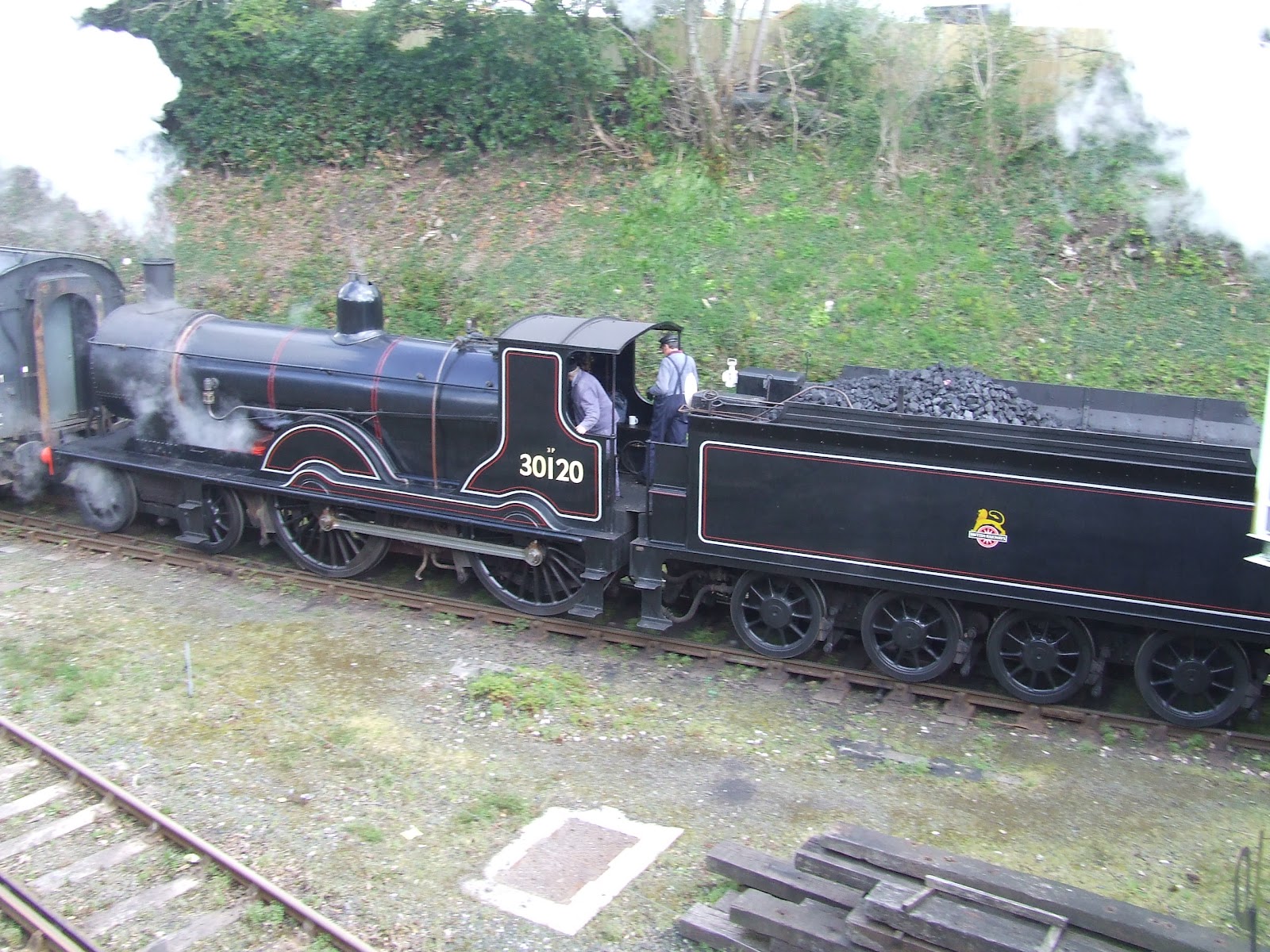
30120 was on an empty stock movement at Bodmin General.

O2 and the Beattie prepare to depart for Bodmin Parkway
5552 working hard on the incline from Bodmin Parkway.
4247 on the incline from Boscarne Junction


The photo of the T9 is probably not the best one we took. I'll post a few more photos of the Steam Spectacular once we have sorted through them all.

During the week I'd taken the opportunity to do a few trips along the Camel trail, taking more photos of Grogley and the Bridges at Boscarne and Pendavey. Postings of these will follow in due course.

A tremendous bonus during the week was finding out that Andrew Jones, the owner of the cottage we were staying in, completed a survey of the line in 1972. His survey recorded how many sleepers were in each rail section; type of sleeper; dates on the chairs; and where occupation crossings were. He also took photos at regular intervals as he walked the line. During our conversations I have gleaned much information which I'm hoping I'll remember correctly. More posts will follow but I must unpack and get ready for Scalefour North tomorrow.

Sunday, 15 April 2012

Clay Wagons GWR dia 013 (part 2)

Just a quick posting to show where I am with the rebuilding of the Ian Kirk clay wagons.

I'd taken the above photo to show progress about a month ago but never did post a blog. The evening had been spent reducing the thickness of two sets of solebars, which can be seen on the relevant wagons. I'd also finished preparing five sets of MJT RCH compensation units. In the foreground can be seen a simple plasticard jig that I'd cut ready for marking the centre lines down the middle of the wagon floor and of each axle. I'm hoping this will help position the compensation units on these wagons and the other dozen or so Ian Kirk clay wagon kits I have waiting to be started.

This next photo shows the current state of play and was taken about two weeks ago. I've only progressed five of the six rebuilds as I'm short on wheel sets. Scalefour North is fast approaching where I hope to be able to replenish stocks of wheels and other items. Waiting in the wings are all the thinned down solebars for these five wagons ready to be installed.
Once I've a few more wheel sets in stock, I'll bring the sixth rebuild to the same state the the five above. I'll then make a start on a couple of the many un-opened bags of Ian Kirk clay wagon kits to bring this rake up to eight. So I hope to make a little more progress on these during May.

Monday, 9 April 2012

Power is installed

I've not posted any blog entries during the last couple of months due to the many projects I have on the go for both my model railway and wargaming hobbies. Trouble is I don't seem to be making much progress on any of them worthy of an entry in either blog. However, during the Easter break, I'd promised myself that I'd find enough time to complete the wiring of my little control panel for Tredethy Wharf and hopefully get something moving on the layout.

The only problem I had with the wiring was working out which two of the three tabs to use on the 9v DC socket. The 9v supply is supplying the power for the point motor circuits in the control panel. The first attempt seemed correct on the bench when tested with the multimeter but in practice did not supply any juice to the point motors. Eventually the fault was traced back to the socket and after some head scratching it was sorted. I've not installed any electromagnets on the layout yet but do intend to experiment with some hands free couplings. To this end I have installed five push buttons on the control panel including all wiring between control panel and the layout. Well there are only four at the moment as I ruined one with a little over zealous soldering.

After running the loco up and down for a while I found a few little gremlins to sort out. To banish one gremlin might require the re-laying of track at the far end where I've installed a continuous check rail. If I do need to re-lay this section I'll use copperclad sleepers next time. All of this section will be buried under road and a dirt track between two buildings so in hindsight the used of ply sleepers and chairs on this section was a little extravagant.

I feel a little happier after my efforts this weekend, but I'm also a little frustrated that it has taken so long to get this little layout to this stage... Anyway, onwards and upwards, I'll keep pecking away at it and one day I might even finish it...

Wednesday, 15 February 2012

Extracts from Trains Illustrated (4) Jan - Dec 1961

These extracts from Trains Illustrated are continuing my search for information on train movements, locomotive allocations and historical events which might have an influence on any of my proposed projects based in and around Wadebridge - Bodmin area. Though most, if not all, of my projects will be fictitious I'm hoping to bring a good slice of historical accuracy to all of them.

April 1961 issue reports:
Western Region
"On January 30 the 5:10 a.m. St.Austell-Plymouth ran into a landslide at Wivelscombe Tunnel, between Saltash and St. Germans, and for the following fortnight the line was closed at this point, except for some freight traffic. Other freight workings and the milk and perishables trains between Cornwall and the east were diverted via Bodmin Road, Wadebridge, Halwill and Okehampton with Type 2 diesel-hydraulic locomotives and S.R. 2-6-0s as motive power. Passenger trains from Cornwall were terminated at St. Germans and a bus service maintained the connection between this station and Saltash, whence a diesel multiple-unit connected with Plymouth, where services from the east were terminated."

July 1961 issue reports:
Southern Region
"Of the U1 2-6-0s Nos. 31898-31900 have been acquired by Salisbury and Nos. 31901-4 by Exmouth Junction. We understand that the U1s will replace T9 4-4-0s in the West Country; all remaining T9 s have been stored to await scrapping ..... Of the South Eastern Division's B.R. Standard Class 2 2-6-2Ts Nos. 84020-3 have travelled to Exmouth Junction.."

September 1961 issue reports:
Western Region
"The bulk of mainline passenger traffic in Cornwall is now diesel-powered by Type 4 units; steam locomotives still work some parcels traffic and most - but not all - the freight traffic. Although the Par-Newquay line is still mainly steam, St. Blazey depot, which covers it, is expected to be all-diesel by the end of the year. At present, too, the Cornish Type 2 diesels have only two daily turns on the Truro-Perranporth-Newquay line, which is worked chiefly by pannier tanks owing to the current non-availability of many 2-6-2Ts of Cornish sheds."

Southern Region
"The S.R. aims to withdraw all the Class T9 4-4-0s, N15 4-6-0, C, C2X and Class 700 0-6-0s and H, and M7 0-4-4Ts as soon as possible and it's latest withdrawals show further steps to the ends with the condemnation of five T9s, Noos. 30117, 30313, 30701/9/17........ The S.R. is particularly anxious to replace its 0-4-4Ts with more modern power and already redundant Class 2 2-6-2Ts nos. 41238/69/1/70/2/83/4/7 have been moved from the L.M.R. ; but the S.R.s' standard Class 2 2-6-2Ts are to be moved to the L.M.R., as the S.R. has not enough of them to justify Regional maintenance of boiler spares."

October 1961 issue reports:
Southern Region
"Exmouth Junction depot has had a clear-out of ex-L.S.W. types. With the departure of Nos 30120 and 30313 for Eastleigh early in July it rid itself of Class T9 4-4-0s and it's stock of Class 700 0-6-0s was eliminated whenn No. 30691left in mid-July. However, No. 30309 (72B) of the latter class travelled through to Ilfracombe with an engineers special from Exeter on August 15, returning to Yeovil two days later."

November 1961 issue reports:
Western Region
"Type 4 "Warship" diesel-hydraulic No. D845 has emerged from Swindon with its roof fronts painted white and four-character head code panels framed in a broad yellow rectangle as a warning device; the Ministry of Transport is believed to be recommending that a prominent yellow warning panel off some kind be applied to the ends of all main line diesel locomotives. Western region Type 4 diesels are also beginning to appear with electrification warning notices a suitable points in their superstructure.."

"Several of the local workings in the Exeter district are now being covered by N.B. Loco. Co. Type 2 diesel-hydraulics, including the Kingswear portion of the up "Cornish Riviera Express"; these locomotives have also taken over the St. Ives branch, Bodmin Road-Wadebridge duties covered by St. Blazey depot and the Hayle-Hayle Docks workings."

December 1961 issue reports:
Southern Region
"B.R. Class 2 2-6-2Ts Nos. 84020/3 were still on Exmouth Junction shed in mid-October, although the S.R.'s entire allocation of this type has been officially transferred to the L.M.R. Exmouth Junction has now regained three 700 Class 0-6-0s; Nos. 30697/8 and 30700 have joined the allocation for winter snowplough work."

The April report of diverted traffic via Bodmin, Wadebridge and Hallwill is a very interesting working... I was also not fully aware when the "Warships" started to appear with yellow warning panels with white trim above the front windows so this information will be very useful if I ever need a Warship...

Sunday, 5 February 2012

Winter Project - Installing Hornblocks

I recently resumed this project by fitting the CSB tags to each of the brass bearings. I then continued with fine tuning the fit of the bearings to each hornblock, when happy with their fit, a length of 0.4mm brass wire was installed through the holes in the bottom of each hornblock to stop the bearings falling out.

I'd then reached the stage where the hornblocks needed to be fitted to the chassis.....


To help me get the get the axles square to the chassis I decided to create a simple jig. I started by drawing a diagram in Adobe Illustrator of a rectangle the width of the chassis frame and longer so that the chassis frame could be aligned over the top. Then two rectangles where drawn to match the wheel base and wider than the chassis to help with aligning the axle jigs at right angles to the chassis frame. This was sellotaped to a mirror, and two strips of plywood secured over the top to help keep the chassis frame true to the diagram.


Once I'd soldered the centre axle into position, the front was aligned using the coupling rods. The jig seems to help in the process as the axles look square to the frame. However I did use a small square to double check before and during soldering the hornblocks to the frame...

State of chassis at the end of the evening...

I feel I've had a reasonable few hours of modelling today. The next task is installing the crankpins into the wheels, then it's building the High Level gearbox before installing the wheels. Think I might take the chassis along to this week's Area Group Meeting for some constructive criticism and advice on the next couple of stages....

Goods vans

"How do I glue van sides together?" was a question I asked myself when confronted with my first van kit for many years. To experienced modellers there is no doubt a simple answer but initially I was stumped.

The first kit I picked up was an old Ian Kirk BR 12T Van, which has buffer beams that are part of the van end so extends below the bottom edge of the van side. Unlike the mineral wagon kits that I'd previously built there seems no common edge with which to align sides to ends allowing me to get the ends and sides square and level to each other. After a few dry practise runs I was getting nowhere. I was trying to use the engineers squares along with packing to align the sides to end in the vertical position. When turning the engineers squares over the solution stared me in the face.

Once each end was glued to a side it was an easy task putting the two halves together. Certainly not ground breaking but I'm happy.

Tuesday, 10 January 2012

Extracts from Trains Illustrated (3) July - Dec 1960

August 1960 issue
"...on the Newquay branch: on June 18 the 7.50 a.m. Newquey-Manchester had a triple-unit combination of Type "4" No. D800 and Type "2s" Nos. D6311/24."

September 1960 issue
"....A correspondent returning from Cornwall in July writes that almost all passenger and parcels trains between Plymouth and Penzance are now diesel-powered, with the later N.B. Loco. Co. Type "2" diesel-hydraulic locomotives now in extensive use as pairs; he adds a further observation of a "Warship" on the Newquay branch, for he recorded No. D801, piloted by "Grange" No. 6816, heading away from the coast with a 15-coach load on the 10 a.m. Newquay-Paddington on July 2. Following last month's report of triple-heading on the Newquay branch, a reader writes that this practice is not uncommon in Cornwall nowadays, seemingly because of the use of Type "2" diesels in pairs. For example, a "Manor" is diagrammed to pilot the 8.55 a.m. (S0) Wolverhampton-Newquay and Penzance from Plymouth to Par; on July 2 this train was headed from Plymouth by a brace of Type "2s", and ahead of them was No. 7816. Some triple-heading is unpremeditated, of course. On July 16 one of two Type"2s" on the 1.20 p.m. Penzance-Paddington failed on Hayle bank: a pannier tank was summoned from Gwinear Road to give assistance as far as Redruth, where it gave place to a "Manor" No. 7813, which triple-headed the diesels, Nos. D6306/9, on to Plymouth....."


December 1960 issue
"...on September 1, Standard Class "4" 2-6-0 No, 76018 was an unusual visitor to North Cornwall; it was sent down from Yeovil to Exmouth Junction to work a Civil Engineer's special to Bude and back, after which it returned to Salisbury on September 3."

I have a soft spot for Standard Class 4 2-6-0s I think it stems from building an Airfix kit in my early 'teens'. Does the last entry allow me to develop the thought that I could justify one running further down the NCR line on an engineers train..? I'd like to think so...